Blog, Press

Two jailed in Senegal for criticising PM on gay rights

By Basillioh Rukanga
Article first appeared on BBC News website

The subject of gay rights came up at a student forum attended by French politician Jean-Luc Mélenchon (L) and Senegal’s Prime Minister Ousmane Sonko (R) (c)AFP

A Senegalese court has jailed two men for “spreading false news” after they accused Ousmane Sonko, the country’s new prime minister, of tolerating homosexuality.

Activist Bah Diakhate and Imam Cheikh Ahmed Tidiane Ndao were jailed for three months and fined 100,000 CFA francs ($165, £130) each.

They had been angered that Mr Sonko had allowed a visiting French politician to express his support for same-sex marriages.

Homosexual acts are banned in the mainly Muslim West African country and are punishable by up to five years in prison.

The political activist and the preacher were arrested two weeks ago after posting a video attacking Mr Sonko for giving a platform to Jean-Luc Mélenchon, a far-left French politician.

Mr Mélenchon gave his opinion about same-sex marriages at a student forum in the capital, Dakar, in mid-May.

His comments reportedly sparked boos from the audience at Cheikh Anta Diop University.

In response Mr Sonko said that Western countries should show restraint on social matters such as LGBTQ rights as it could “lead to anti-Western sentiment”.

Senegal would continue to manage issues around homosexuality in accordance with its socio-cultural norms, the prime minister said.

He was quoted as saying that homosexuality was “not accepted, but tolerated” in Senegal.

Mr Sonko, a former firebrand opposition leader, was appointed prime minister in April after his ally Bassirou Diomaye Faye was elected president.

They were freed from prison not long before the vote in an amnesty aimed at calming months of political turmoil after the outgoing president had tried to postpone the election.

The pair campaigned on a promise of radical change – with an Afrocentric and nationalist agenda, promising to reset Senegal’s relationship with France, the country’s former colonial power.

Blog, Press

Senegal’s Parliament rejects bill to increase penalties for homosexuality

‘We don’t need a law based on emotions that fills up our prisons

This article first appeared May 6th on 76crimes.com. It was translated into English from the website of  the French  LGBTQ rights group Stop Homophobie : It was written by MOÏSE MANOËL-FLORISSE


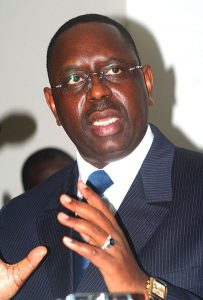
Macky Sall (Photo courtesy of Wikipedia)
Senegal President Macky Sall (Photo courtesy of Wikipedia)

On Friday, April 28, Senegal’s Parliament rejected a series of proposals, including a text that would toughen the criminalization of homosexuality, already punishable by one to five years in prison and a fine (Article 319 of the Penal Code, dating from 1966).

The initiative was supported by the opposition, which denounced “a mechanical majority blockade” after years of advocacy and intense lobbying by religious groups, including “And Samm Jikko” (“Together to Safeguard Values”). Founded by the Islamist [advocacy group] Jamra, the group called for a new law against what it considers “unnatural” acts.

But, as stated by the office of the Assembly, since the acts in question are already banned, this bill, which is “insignificant in reality”, is “inadmissible”. “It brings nothing to the public debate”, and if it had been voted, “it would have no impact”, on the contrary. And it is “neither courageous nor relevant” to do so, given the social situation of the country.

“We don’t need a law based on emotions that fills up our prisons,” insisted a legislator from President Macky Sall’s majority party.

Parliament had already rejected a similar bill in January 2022, which would have doubled the penalties for homosexuality from 5 to 10 years in prison, with a fine of up to 5 million CFA francs (more than 6,600 euros) and without the possibility of exceptions for mitigating circumstances. The text also targeted “lesbianism, bisexuality, transsexuality, intersexuality, zoophilia, necrophilia…” as similar practices.


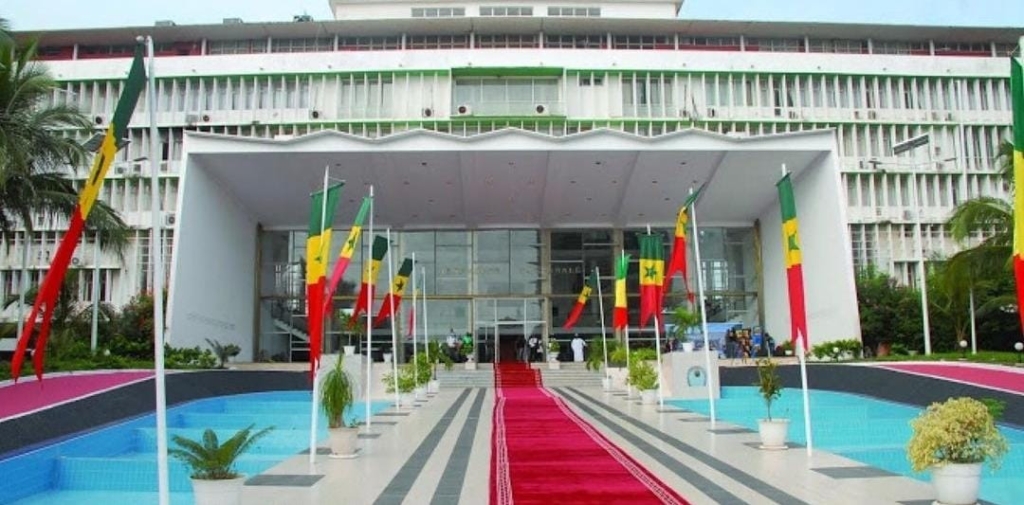
The Parliament Building in Dakar, Senegal  (Photo courtesy of  @aly_ngouille_ndiaye)