By Nana Davis Mac‑Iyalla
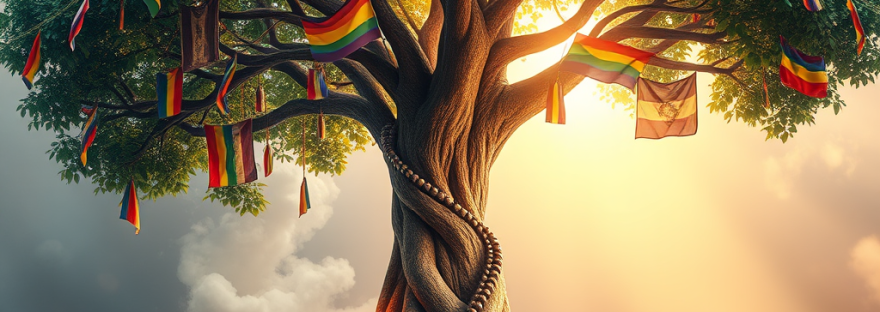
Across West Africa and throughout the diaspora, I have witnessed a truth that too many institutions still refuse to name: our spiritual lives and our sexual identities do not grow on separate branches. They are intertwined roots of the same human tree. When one is starved, the whole person suffers. When one is nourished, the whole person rises.
For LGBTQ+ people—especially those raised in deeply religious environments—this truth is not theoretical. It is lived in our bodies, our prayers, our silences, and our rebellions. It is lived in the long nights when we try to negotiate with a God we were taught to fear, and in the bright mornings when we finally meet a God who loves us without condition.
The Violence of Forced Fragmentation
Too many of us were taught that to be spiritual, we must amputate our sexuality. That to be faithful, we must lie about who we love. That to be accepted, we must shrink ourselves into theological closets built by other people’s fears.
This fragmentation is not accidental. It is a tool of control.
When a society demands that LGBTQ+ people choose between their faith and their identity, it is not protecting morality. It is protecting power. It is preserving a hierarchy where some bodies are deemed holy and others are treated as theological mistakes.
But we are not mistakes. We are not contradictions. We are not spiritual exiles.
We are whole.
The Courage of Integration
The journey toward integrating spiritual and sexual identity is not easy. It requires unlearning shame that was never ours. It requires confronting religious leaders who weaponize scripture. It requires rebuilding a spiritual home from the ground up—brick by brick, truth by truth.
But integration is also liberation.
It is the moment a lesbian woman in Ghana prays in her own language and realizes God never stopped listening. It is the moment a bisexual man in Nigeria stops apologizing for existing. It is the moment a queer youth in the diaspora discovers that their ancestors walked with spirits long before colonial doctrines arrived.
Integration is not about choosing between God and self. It is about refusing to believe they were ever in conflict.
Why Activism Must Embrace Both
Activism that focuses only on sexual rights but ignores spiritual trauma is incomplete. Activism that celebrates pride but avoids the wounds inflicted by churches, mosques, and temples leaves our people half‑healed.
We must build movements that understand:
- Sexual identity development is a journey of truth-telling.
- Spiritual development is a journey of meaning-making.
- Both are essential to human dignity.
When we create spaces where LGBTQ+ people can explore both without fear, we are not just supporting individuals—we are dismantling systems that depend on our silence.
A Call to Faith Leaders
To my fellow faith leaders across Africa and the diaspora: neutrality is no longer an option. Silence is not compassion. Ambiguity is not pastoral care.
If your theology cannot hold the fullness of LGBTQ+ lives, then it is your theology—not our existence—that needs transformation.
A Call to Our Communities
To my LGBTQ+ siblings: your journey is sacred. Your questions are holy. Your desire to belong—to God, to community, to yourself—is not a weakness but a sign of your spiritual strength.
You do not need to choose between your faith and your identity. You deserve both. You were born for both.
Becoming Whole Is an Act of Resistance
In a world that profits from our fragmentation, wholeness is revolutionary. Every time we claim our sexuality and our spirituality in the same breath, we disrupt centuries of oppression. Every time we refuse to hide, we expand the possibilities for those who will come after us.
This is the work. This is the calling. This is the liberation we are building—one integrated life at a time.
 Interfaith Diversity Network of West Africa