Blog, Press

Becoming Whole: Why Spiritual and Sexual Identity Development Must Be Fought for Together

By Nana Davis Mac‑Iyalla

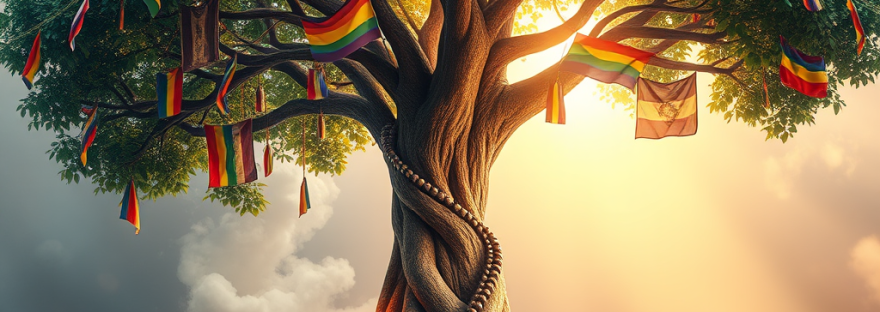
Across West Africa and throughout the diaspora, I have witnessed a truth that too many institutions still refuse to name: our spiritual lives and our sexual identities do not grow on separate branches. They are intertwined roots of the same human tree. When one is starved, the whole person suffers. When one is nourished, the whole person rises.

For LGBTQ+ people—especially those raised in deeply religious environments—this truth is not theoretical. It is lived in our bodies, our prayers, our silences, and our rebellions. It is lived in the long nights when we try to negotiate with a God we were taught to fear, and in the bright mornings when we finally meet a God who loves us without condition.

The Violence of Forced Fragmentation

Too many of us were taught that to be spiritual, we must amputate our sexuality. That to be faithful, we must lie about who we love. That to be accepted, we must shrink ourselves into theological closets built by other people’s fears.

This fragmentation is not accidental. It is a tool of control.

When a society demands that LGBTQ+ people choose between their faith and their identity, it is not protecting morality. It is protecting power. It is preserving a hierarchy where some bodies are deemed holy and others are treated as theological mistakes.

But we are not mistakes. We are not contradictions. We are not spiritual exiles.

We are whole.

The Courage of Integration

The journey toward integrating spiritual and sexual identity is not easy. It requires unlearning shame that was never ours. It requires confronting religious leaders who weaponize scripture. It requires rebuilding a spiritual home from the ground up—brick by brick, truth by truth.

But integration is also liberation.

It is the moment a lesbian woman in Ghana prays in her own language and realizes God never stopped listening. It is the moment a bisexual man in Nigeria stops apologizing for existing. It is the moment a queer youth in the diaspora discovers that their ancestors walked with spirits long before colonial doctrines arrived.

Integration is not about choosing between God and self. It is about refusing to believe they were ever in conflict.

Why Activism Must Embrace Both

Activism that focuses only on sexual rights but ignores spiritual trauma is incomplete. Activism that celebrates pride but avoids the wounds inflicted by churches, mosques, and temples leaves our people half‑healed.

We must build movements that understand:

  • Sexual identity development is a journey of truth-telling.
  • Spiritual development is a journey of meaning-making.
  • Both are essential to human dignity.

When we create spaces where LGBTQ+ people can explore both without fear, we are not just supporting individuals—we are dismantling systems that depend on our silence.

A Call to Faith Leaders

To my fellow faith leaders across Africa and the diaspora: neutrality is no longer an option. Silence is not compassion. Ambiguity is not pastoral care.

If your theology cannot hold the fullness of LGBTQ+ lives, then it is your theology—not our existence—that needs transformation.

A Call to Our Communities

To my LGBTQ+ siblings: your journey is sacred. Your questions are holy. Your desire to belong—to God, to community, to yourself—is not a weakness but a sign of your spiritual strength.

You do not need to choose between your faith and your identity. You deserve both. You were born for both.

Becoming Whole Is an Act of Resistance

In a world that profits from our fragmentation, wholeness is revolutionary. Every time we claim our sexuality and our spirituality in the same breath, we disrupt centuries of oppression. Every time we refuse to hide, we expand the possibilities for those who will come after us.

This is the work. This is the calling. This is the liberation we are building—one integrated life at a time.

Blog, Press

Sitting Tall: Gay Chief Davis Mac Iyalla’s Queer Leadership in the Heart of Ghana

Article by Nompilo GwalaMamba Online.com

Davis Mac Iyalla, a queer spiritual leader and out gay chief in Ghana, embodies defiant visibility and ancestral wisdom in equal measure

Ghana’s Parliament has reopened debate on one of Africa’s toughest anti LGBTQ+ bills, just a year after the previous version expired without presidential assent.

The reintroduced Human Sexual Rights and Family Values Bill seeks to raise prison terms for same sex intimacy and criminalise “promotion” of queer rights.

Yet even as legislators press ahead, a very different story is unfolding in the fishing town of Yamonransa on the country’s Cape Coast.

There, Nana Kwaku Gyasi, Chief Davis Mac Iyalla, who is also Executive Director of the Interfaith Diversity Network of West Africa (IDNOWA), is teaching that visibility itself can be an act of love.

“I came out the day I was born”

Mac Iyalla rejects western notions of a single, dramatic “coming out.”

“I came out to the world the day I was born,” he tells MambaOnline. “My concept of coming out is about speaking out, using your voice to challenge injustice.”

That conviction first catapulted him into headlines a quarter century ago, when he confronted the Anglican Church of Nigeria over its homophobia.

Today he carries the same fire into Ghanaian life, defiantly testifying before Parliament against the anti-LGBTQ+ bill and preaching inclusion from pulpits across West Africa.

Chosen by the ancestors

Three years ago, Mac Iyalla was lifted onto a traditional palanquin (also known as a litter, used to carry chiefs, kings, and other important figures during ceremonies and festivals) and installed as Amankorehen (development chief) of Yamonransa.

Some rival chiefs tried, literally, to topple him; the palanquin collapsed and tabloids declared that “the gods had rejected” a gay chief.

The activist tells a very different story: “I was chosen by the ancestors,” he says. “If homosexuality were truly a taboo, I would never have been allowed to sit on the stool.” (In Ghanaian chieftaincy, the stool is not just a seat but a central symbol of leadership and authority.)

His stool still stands. So do his community projects: youth apprenticeships, widows’ micro grants and IDNOWA’s dialogue circles that bring imams, pastors and traditional priests to the same table.

Chief Davis Mac Iyalla being carried on a traditional palanquin used during ceremonies and festivals

An out gay chief changing hearts at village level

While urban activists tweet and rally, Mac Iyalla works face to face with local “gate keepers”, chiefs, queen mothers and clan elders whose word shapes daily life.

“Most people don’t care about my sexuality,” he explains. “They care about the development I bring.”

That pragmatism is paying off. Elders who once kept silent now greet him publicly; church women volunteer at IDNOWA food drives; parents ask how to protect queer children rather than punish them.

“Changing attitudes takes time,” the chief says, “but conversations have begun, and that is huge for West Africa.”

Faith without fear

For Mac Iyalla, queer joy is inseparable from spirituality. IDNOWA’s credo is simple: “All humans are born free and equal.”

Founded in 2016, the network spans 11 West African countries, equipping clergy and activists to confront religiously framed homophobia with scripture, history and Ubuntu ethics.

Last September, Mac Iyalla preached in the Netherlands, urging Christians to “reshape the world by speaking out against all forms of injustice.”

A message to queer African youth

“You are not a taboo. You are not ‘un-African’. Same sex love existed on this continent long before colonial missionaries,” Mac Iyalla asserts.

“If God and your ancestors are with you, no weapon fashioned by anti gender movements will succeed.”

He urges young people who feel safe enough to “take the risk and be counted,” while reminding them that leadership also happens quietly, in classrooms, clinics and marketplaces where queer Africans already serve.

Why this story matters

Mac Iyalla’s journey does not erase Ghana’s political peril, but it illuminates a parallel reality: LGBTQ+ Ghanaians are farmers, teachers, chiefs and prayer leaders. They are “everywhere,” as he likes to say, and in many cases they are thriving.

In a season when anti queer rhetoric dominates headlines, Chief Davis Mac Iyalla stands as living proof that African tradition can coexist with and celebrate queer identity. His life invites us to imagine a future in which ancestral stools make room for every kind of child born to the continent.

Until that day arrives, he will keep doing what chiefs are meant to do: build, protect and speak the truth. And that, in itself, is queer joy.

Blog, Press

ILGA World Conference

The Executive Director and Members of Interfaith Diversity Network of West Africa (IDNOWA ) participated at the ILGA (the International Lesbian, Gay, Bisexual, Trans and Intersex Association) World Conference 2024 in Cape Town, South Africa.

The ILGA World Conference is the largest global gathering of LGBTIQ changemakers. They have held them since the early days of the organisation in the 1970s.

An ILGA World Conference is a chance to assess where our communities stand, share experiences and best practices, build alliances and partnerships, discuss the future of the movement, and collectively chart ways to advance equality worldwide.

ILGA World Conference is also where the life of the organisation is shaped. ILGA members elect their representatives, advance proposals and constitutional changes, and endorse new organisations to join our family.

ILGA World is queer democracy in action, and it all starts from ILGA World Conferences.

In his closing remarks, Davis Mac-Iyalla, IDNOWA Executive Director, said,

We can’t change the world in one week, but we can try to listen to each other and find strategies to change the negative attitude and discrimination towards us and our community.
We are stronger together in this struggle. Let’s not allow our enemies to divide us and set the ring for us to fight each other while they watch in jubilation.
As an African, my concepts for dialogue are always Ubuntu.”

About ILGA

On their website (ilga.org/) ILGA says,

ILGA World – the International Lesbian, Gay, Bisexual, Trans and Intersex Association – is a worldwide federation of more than 1,900 organisations from over 160 countries and territories campaigning for lesbian, gay, bisexual, trans and intersex human rights.

We want a world where the human rights of all are respected and where everyone can live in equality and freedom: a world where global justice and equity are assured and established regardless of people’s sexual orientations, gender identities, gender expressions and sex characteristics (SOGIESC).

Established in 1978, ILGA World has ECOSOC consultative status at the United Nations.