IDNOWA has formally written to the Minority Leader of the Parliament of Ghana, Hon. Alexander Afenyo‑Markin, appealing for responsible leadership and urging Parliament not to use the Anti‑LGBTIQ Bill as a tool for retaliation or political pressure.
Our message is simple and grounded in Ghana’s constitutional values: every citizen deserves protection, dignity, and fairness—regardless of sexual orientation, ethnicity, gender, or religion.
Dear Hon. Alexander Afenyo‑Markin, Minority Leader, Parliament of the Republic of Ghana,
I extend my respectful greetings to you and your distinguished office. I am writing in my capacity as Executive Director of the Interfaith Diversity Network of West Africa (IDNOWA), an organisation committed to promoting peaceful coexistence, mutual respect, and the protection of all citizens irrespective of their background, beliefs, or identity.
I wish to respectfully appeal to your good office regarding the ongoing calls for the passage of the Anti‑LGBTIQ Bill. My concern is not rooted in politics, but in the shared responsibility we all bear to safeguard Ghana’s democratic values, human dignity, and long‑standing traditions of tolerance.
IDNOWA is not advocating for special privileges or political advantage for any group. Our position is simple: every Ghanaian deserves equal protection under the law, regardless of sexual orientation, ethnicity, or religion. This principle aligns with Ghana’s constitutional commitments and with the moral foundations of our diverse cultural and faith traditions.
Historically, our ancestors lived in communities where differences were managed with wisdom rather than punishment. They did not build prisons for people based on their private lives or identities. Instead, they upheld a social fabric that valued harmony, coexistence, and respect for diversity. These values have shaped Ghana into a nation admired for its stability and humanity.
At a time when the country faces significant economic and social challenges, prioritising legislation that targets vulnerable citizens risks diverting national attention from urgent development needs. It also risks deepening divisions at a moment when unity is essential. Ghana’s reputation as a democratic, rights‑respecting nation has been earned through decades of careful leadership—leadership that you now embody in your role as Minority Leader.
I therefore appeal to your conscience, your sense of justice, and your commitment to Ghana’s democratic heritage. Your influence can help ensure that Parliament does not become a tool for retaliation or exclusion, but remains a place where every citizen feels represented and protected. This moment calls for leadership that rises above political tensions and affirms the dignity of all Ghanaians.
I trust in your wisdom and your ability to guide Parliament toward decisions that strengthen our national cohesion and uphold the values that define us as a people.
Thank you for your service to Ghana and for considering this respectful appeal.
Yours sincerely,
Davis Mac‑Iyalla
Executive Director Interfaith Diversity Network of West Africa (IDNOWA)
By Nana Davis Mac-Iyalla Executive Director of IDNOWA
Ghana’s Parliament has, once again, reintroduced the so-called Proper Human Sexual Rights and Ghanaian Family Values Bill—a Private Member’s Bill that seeks to criminalize LGBTQ+ identities, advocacy, and even journalism. But just like its predecessor introduced in 2021, this bill is not only discriminatory—it is unconstitutional.
⚖️ Article 108: The Bill’s Fatal Flaw
Under Article 108 of the 1992 Constitution, the Speaker of Parliament is prohibited from allowing any bill that imposes a financial burden on the State unless it is introduced by the government. This bill proposes prison sentences of up to 10 years for individuals who “promote” LGBTQ+ rights—including journalists, allies, and advocates.
That means:
Convicts must be housed, fed, and secured—at the taxpayer’s expense.
The bill is not government-sponsored, yet it mandates costly enforcement.
This is a textbook violation of Article 108. The Speaker is constitutionally barred from proceeding. Any attempt to do so undermines the integrity of Parliament and the rule of law.
📉 A Bill That Lapsed—and Should Stay Buried
The original version of this bill, introduced in 2021, lapsed without passage. It was widely condemned by legal experts, human rights defenders, and international observers. Its reintroduction in 2025 is not a revival—it’s a repetition of error.
🗣️ Legacy, Clarity, and Constitutional Courage
Let it be known: this bill is dead on arrival. No amount of posturing or moral panic can override the Constitution. Ghana’s democracy is not a playground for populist punishment. We must anchor our laws in justice, clarity, and fiscal responsibility.
To every journalist, advocate, and citizen who refuses to be silenced—stand firm. The Constitution is on your side. And to those who seek to weaponize Parliament against dignity and truth: the law has spoken. You may reintroduce the bill, but you cannot resurrect its legitimacy.
Press Release For Immediate Release Date: 11 August 2025 Contact: Interfaith Diversity Network of West Africa (IDNOWA) Email: info@idnowa.org
IDNOWA Leads Bold Dialogue on Human Rights and Inclusion Amid Ghana’s Anti-LGBT Bill Debate
Accra, Ghana — On 4 August 2025, the Interfaith Diversity Network of West Africa (IDNOWA) hosted a landmark sensitization workshop aimed at promoting human rights awareness and fostering inclusive dialogue among religious and traditional leaders. The event comes at a critical time, as Ghana’s Parliament reconsiders the controversial anti-LGBT bill, raising alarm among civil society and international observers.
The workshop brought together a diverse group of faith leaders, human rights educators, and civil society representatives to explore the intersection of religion, culture, and inclusion. Through presentations, group discussions, and personal storytelling, participants examined the social and legal implications of the proposed legislation and reaffirmed their commitment to dignity and equality for all.
“This workshop is not just a conversation—it’s a commitment to justice,” said Davis Mac-Iyalla, Executive Director of IDNOWA. “We must continue to challenge exclusionary narratives and empower leaders to stand for compassion and equality.”
IDNOWA has been at the forefront of promoting inclusion across West Africa, using interfaith dialogue to dismantle stigma and build bridges between communities. The organization’s ongoing efforts include educational outreach, advocacy campaigns, and strategic partnerships with local and international stakeholders.
Key Outcomes: Increased empathy and understanding among religious leaders.
Commitments to promote inclusive practices within faith communities.
Heightened awareness of the anti-LGBT bill’s risks to civil liberties.
Recommendations: Continued engagement through follow-up workshops.
Development of tailored educational materials for faith communities.
Strengthened partnerships with advocacy groups to support inclusive policy dialogue.
This workshop underscores IDNOWA’s unwavering dedication to human rights and its strategic role in shaping a more inclusive West Africa.
For interviews, media inquiries, or further information, please contact: IDNOWA Communications Team 📧 info@idnowa.org 🌐 Visit our press page
Davis Mac Iyalla, a queer spiritual leader and out gay chief in Ghana, embodies defiant visibility and ancestral wisdom in equal measure
Ghana’s Parliament has reopened debate on one of Africa’s toughest anti LGBTQ+ bills, just a year after the previous version expired without presidential assent.
The reintroduced Human Sexual Rights and Family Values Bill seeks to raise prison terms for same sex intimacy and criminalise “promotion” of queer rights.
Yet even as legislators press ahead, a very different story is unfolding in the fishing town of Yamonransa on the country’s Cape Coast.
There, Nana Kwaku Gyasi, Chief Davis Mac Iyalla, who is also Executive Director of the Interfaith Diversity Network of West Africa (IDNOWA), is teaching that visibility itself can be an act of love.
“I came out the day I was born”
Mac Iyalla rejects western notions of a single, dramatic “coming out.”
“I came out to the world the day I was born,” he tells MambaOnline. “My concept of coming out is about speaking out, using your voice to challenge injustice.”
That conviction first catapulted him into headlines a quarter century ago, when he confronted the Anglican Church of Nigeria over its homophobia.
Today he carries the same fire into Ghanaian life, defiantly testifying before Parliament against the anti-LGBTQ+ bill and preaching inclusion from pulpits across West Africa.
Chosen by the ancestors
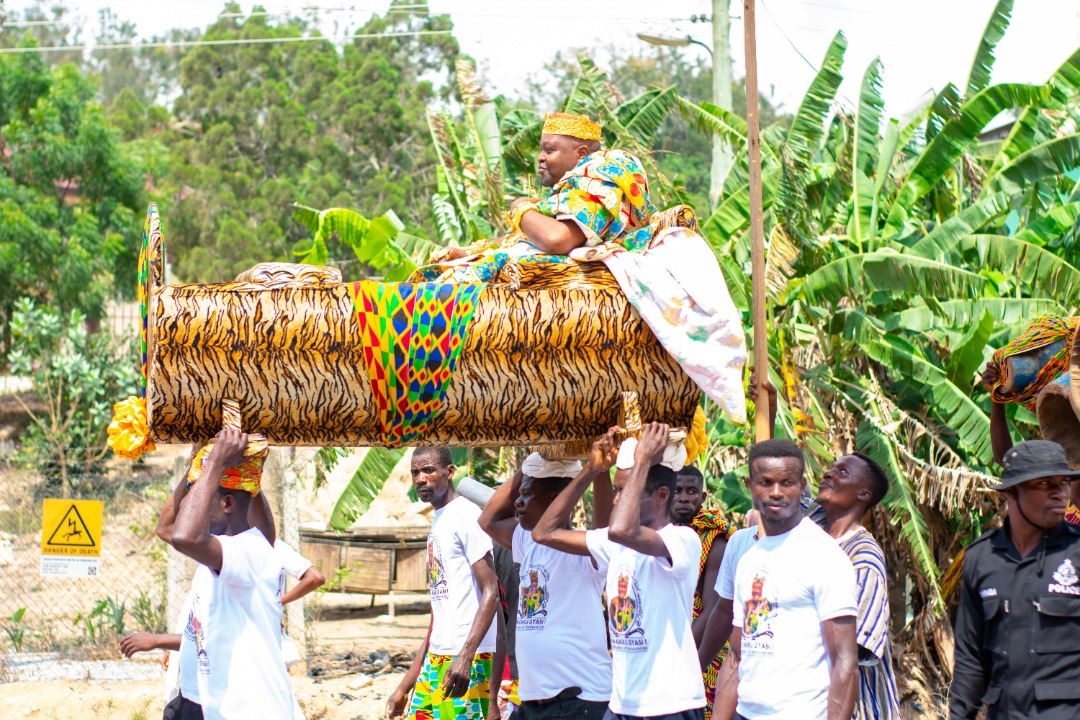
Three years ago, Mac Iyalla was lifted onto a traditional palanquin (also known as a litter, used to carry chiefs, kings, and other important figures during ceremonies and festivals) and installed as Amankorehen (development chief) of Yamonransa.
Some rival chiefs tried, literally, to topple him; the palanquin collapsed and tabloids declared that “the gods had rejected” a gay chief.
The activist tells a very different story: “I was chosen by the ancestors,” he says. “If homosexuality were truly a taboo, I would never have been allowed to sit on the stool.” (In Ghanaian chieftaincy, the stool is not just a seat but a central symbol of leadership and authority.)
His stool still stands. So do his community projects: youth apprenticeships, widows’ micro grants and IDNOWA’s dialogue circles that bring imams, pastors and traditional priests to the same table.
Chief Davis Mac Iyalla being carried on a traditional palanquin used during ceremonies and festivals
An out gay chief changing hearts at village level
While urban activists tweet and rally, Mac Iyalla works face to face with local “gate keepers”, chiefs, queen mothers and clan elders whose word shapes daily life.
“Most people don’t care about my sexuality,” he explains. “They care about the development I bring.”
That pragmatism is paying off. Elders who once kept silent now greet him publicly; church women volunteer at IDNOWA food drives; parents ask how to protect queer children rather than punish them.
“Changing attitudes takes time,” the chief says, “but conversations have begun, and that is huge for West Africa.”
Faith without fear
For Mac Iyalla, queer joy is inseparable from spirituality. IDNOWA’s credo is simple: “All humans are born free and equal.”
Founded in 2016, the network spans 11 West African countries, equipping clergy and activists to confront religiously framed homophobia with scripture, history and Ubuntu ethics.
Last September, Mac Iyalla preached in the Netherlands, urging Christians to “reshape the world by speaking out against all forms of injustice.”
A message to queer African youth
“You are not a taboo. You are not ‘un-African’. Same sex love existed on this continent long before colonial missionaries,” Mac Iyalla asserts.
“If God and your ancestors are with you, no weapon fashioned by anti gender movements will succeed.”
He urges young people who feel safe enough to “take the risk and be counted,” while reminding them that leadership also happens quietly, in classrooms, clinics and marketplaces where queer Africans already serve.
Why this story matters
Mac Iyalla’s journey does not erase Ghana’s political peril, but it illuminates a parallel reality: LGBTQ+ Ghanaians are farmers, teachers, chiefs and prayer leaders. They are “everywhere,” as he likes to say, and in many cases they are thriving.
In a season when anti queer rhetoric dominates headlines, Chief Davis Mac Iyalla stands as living proof that African tradition can coexist with and celebrate queer identity. His life invites us to imagine a future in which ancestral stools make room for every kind of child born to the continent.
Until that day arrives, he will keep doing what chiefs are meant to do: build, protect and speak the truth. And that, in itself, is queer joy.
On Tuesday, August 14, 2024, Rightify Ghana’s Director had the honour of meeting Pope Francis at the Vatican.
With LGBTQI+ criminalisation rising in Africa, and Ghana’s anti-LGBTQI+ bill pending, we shared our experiences as queer individuals in Ghana and expressed gratitude to the Pope for his progressive stance, especially his opposition to violence and discrimination.
Pope Francis encouraged us to “keep fighting for your rights,” and that’s exactly what we will do.
We’re also grateful for the meaningful gifts we received—they will always hold a special place for us.
On Tuesday, August 14, 2024, Rightify Ghana's Director @Ebenezer_Peegah had the honour of meeting Pope Francis @Pontifex at the Vatican.
With LGBTQI+ criminalisation rising in Africa, and Ghana's anti-LGBTQI+ bill pending, we shared our experiences as queer individuals in.. pic.twitter.com/tYfW1X4W6D
Speaker of the Ghana Parliament, Rt Hon Alban Sumana Kingsford Bagbin, has reaffirmed his commitment to opposing the legalization of LGBTQ+ activities in Ghana.
He disclosed this at Our Lady Seat of Wisdom Catholic Church in Oyarifa, Accra, during its Patronal Feast Day.
Rt Hon Bagbin declared that he would rather die than support LGBTQ+ rights, which he believes are driven by negative forces and should not be accepted in Ghana.
He criticized European countries for promoting homosexuality in the African continent and urged the Catholic community to disregard media claims that the Pope has endorsed LGBTQ+ activities.
Speaker Bagbin stated that LGBTQ+ rights do not exist anywhere in the world and will not be legalized in Ghana during his tenure.
“Let me say that, as a Catholic, I will not do anything that will end the world and as I always say, I prefer to die fighting against these homosexual activities than to protect their so-called rights,” the Speaker of Parliament said.
The anti-gay bill, which promotes traditional family values, has been passed by Parliament and is awaiting the President’s assent to become law.
Rt Hon Bagbin praised the Catholic Church for its support and contributions to national development, particularly in education, health, and social services.
He highlighted the Church’s role in advocating for social justice and human rights, including efforts to abolish the death penalty and criminalize witchcraft accusations.
“Let me commend the church for taking the principled stand of speaking out against injustice and championing the cause of the marginalized. This important role by the church ensures that the nation moves towards greater equity and inclusion, creating a just society where everyone has the opportunity to succeed.”
“Indeed, it is an open secret that many of the schools, hospitals, and charitable organizations that provide essential services, especially in underserved communities in Ghana have been led by the Church. These institutions do not only address the immediate needs of the people but also empower individuals through education and healthcare, thus contributing to a more informed and healthier populace,” Speaker Bagbin added.
He urged the Church to continue pressing the Executive to pass important legislation, such as the Armed Forces Amendment Act and laws against witchcraft accusations. Bagbin also donated GHS20,000 towards the Church’s new chapel project, emphasizing the importance of promoting ethical and moral values.
In his sermon, Most Rev. John Kobina Louis encouraged church members to seek the intercession of Mary, the Mother of Jesus, for wisdom and endurance.
The Church’s Pastoral Council Chairman, Henry Adjei expressed gratitude to Rt Hon Bagbin and the Auxiliary Bishop for their support.
According to him, the Church started 28 years ago and has a congregation of over 1,500 members, noting that, the new chapel project is estimated to host over 2000 congregations when completed and assured that the Speaker and the Bishop would be invited for commissioning.
Open Letter from the Interfaith Diversity Network of West Africa to the Most Rev. Philip Naameh, Chair of the Ghana Catholic Bishops Conference
05 March 2024
Dear Most Rev. Philip Naameh,
We urge you and the Catholic bishops in Ghana to reconsider your stance toward the now-passed “Human Sexual Rights and Family Values Act, 2024.” Ask the President not to assent to it. Pledge to support LGBT+ Ghanaians with human rights advocacy and pastoral care. Take back the religious independence which this Act wrongfully arrogates to the civil authority.
We urge you and your fellow bishops to read the Act carefully. This Act criminalizes people who “hold out as” LGBT+ (section 4.1). It criminalizes spiritual caregivers, family, and friends, who do not immediately report LGBT+ people to the police (sections 4 and 17). And it protects anti-LGBT+ media which styles itself as a “response to any form of advocacy or activism,” no matter how “graphic” or hateful that media may be
Criminalizing people on the basis of their inward dispositions is wrong. As Pope Francis stated on 5 February, 2023: “Criminalising people with homosexual tendencies is an injustice.” We urge you to follow the Pope’s leadership.
LGBT+ people often share their thoughts and their struggles with spiritual caregivers, family, and friends. Forcing these caregivers to report LGBT+ people to the police is a shocking overreach of government power. How can spiritual leaders like yourselves tolerate such a provision in the law?
Giving sanction to graphic anti-LGBT+ propaganda in education, instruction, and public media encourages hatred and violence. To support this kind of legalized vitriol is to cry “Peace! Peace!” where there is no peace (Jer 6:14).
Your support for this Act has created panic among many of the LGBT+ people of Ghana, and among many of the people who love them. Those who look to you for action are desperate. Many turn to the Church as a last place of refuge and support. Do not chase souls away. Do not lead our society into greater conflict and vitriol. Do not abandon the persecuted, and lead their persecutors astray.
IDNOWA affirms the teaching of the Catholic Church that LGBT+ people “must be accepted with respect, compassion, and sensitivity;” that “every sign of unjust discrimination in their regard should be avoided” (CCC 2358).
We believe that our sexual orientations and gender identities belong to God’s creation and are part of his plan for the salvation of humankind, while the Magisterium of the Catholic Church teaches that “homosexual acts are intrinsically disordered” and that “under no circumstances can they be approved” (CCC 2357). On this we disagree. But we affirm with you the Magisterium’s teaching on the dignity of LGBT+ people: “It is deplorable that homosexual persons have been and are the object of violent malice in speech or in action. Such treatment deserves condemnation from the Church’s pastors wherever it occurs. It reveals a kind of disregard for others which endangers the most fundamental principles of a healthy society.” No matter what a person may “hold out” to be, “the intrinsic dignity of each person must always be respected in word, in action and in law” (Letter to the Bishops of the Catholic Church on the Pastoral Care of Homosexual Persons, 10). On this, all people of good will should agree.
Now that the Act has been passed by Parliament, the Ghanaian government has begun to weigh its costs and its dangers. The bishops, too, should weigh its effects very carefully.
We urge you to ask the President not to assent to it.
We urge you to pledge your support for the human rights of LGBT+ Ghanaians; and for their right to access pastoral care and personal counselling in freedom.
If this law gains Presidential assent, we urge you to support LGBT+ Ghanaians and the people who love them with legal assistance. Give them lawyers and legal support when they are arrested and jailed under this unjust and un-Christian law.
In the past several years, IDNOWA has made efforts to engage with you and the Ghana Catholic Bishops Conference, but we have never received an invitation to further dialogue. In the spirit of synodality, ask us to talk with you. Walk together with us, so that you can hear the voices of LGBT+ Ghanaians – both Catholic and non-Catholic. Let us together build a more peaceful, more just society.
Sincerely, Davis Mac Iyalla Executive Director of Interfaith Diversity Network of West Africa interfaithdiversitynowa@gmail.com
IDNOWA’s Executive Director, Davis Maclyalla paid a courtesy visit to the Executive Director and staff of the Centre for Religion and Public Life Ghana in their Accra office on Tuesday, 30th January 2024. IDNOWA visited the centre to discuss collaboration and to explore avenues for providing inclusive, safe, and pastoral care for marginalised people in Ghana, mostly the LGBT+ people. IDNOWA was well received, and we presented the CRPL-Ghana team with copies of our booklet, where we have documented the violation of the human rights of LGBT+ persons in Ghana. There is much evidence to engage parliamentarians and government to state why the anti gay bill shouldn’t be passed .
A prominent Ghanaian priest, cardinal Peter Turkson of the Roman Catholic church has spoken against criminalizing homosexuality, challenging the proposed bill in Ghana’s parliament that seeks severe penalties for the LGBTQ+ community.
This statement contradicts the position of other Roman Catholic bishops in Ghana who have labelled homosexuality a crime.
The backdrop of this discussion involves ongoing parliamentary debates on a bill that could lead to three-year prison sentences for identifying as LGBT, with up to 10 years for those advocating for LGBTQ+ rights.
Cardinal Turkson’s perspective diverges from the traditional stance of the Church, aligning more closely with Pope Francis, who recently indicated openness to blessing same-sex couples.
However, the Pope clarified that the Church still considers same-sex relationships as “objectively sinful” and does not endorse same-sex marriage.
In a recent interview with the BBC, Cardinal Turkson emphasized the need for education to foster understanding of homosexuality, asserting that LGBT individuals should not be criminalized since they have committed no crime.
Despite acknowledging cultural nuances, Cardinal Turkson criticized the influence of foreign donations on African countries’ anti-LGBT measures, cautioning against imposing positions on cultures not ready to accept them.
This commentary comes amid similar legislative developments in other African nations, such as Uganda, where a law proposing life imprisonment and even death penalties for homosexuality has raised international concerns.
Cardinal Turkson, the first-ever Ghanaian cardinal appointed in 2003, holds a prominent position as the chancellor of the Pontifical Academies of Sciences.
Davis Mac-Iyalla has spent years campaigning for the rights of LGBTQ+ people in Ghana. (The Kaleidoscope Trust)
In January 2023, LGBTQ+ activist Davis Mac-Iyalla was installed as a chief of the Yamonransa Nkusukum area in central Ghana.
With the title of Amankorehen, the Nigerian-born activist’s role is “like a foreign minister for the traditional area” and a huge honour for him. But during the ceremony he was nearly thrown from his platform in an act he says was “set up” by homophobic figures to “disgrace” him.
As part of the ceremony, Mac-Iyalla was carried through the streets on a platform called a palanquin, and a fall from this to the ground could have killed or seriously injured him.
The local media, who Mac-Iyalla did not invite to the event, managed to “spy” on the incident and published the reactionary headline “Gay rights activist installed as a chief”, knowing it would be a “serious issue”.
Mac-Iyalla tells PinkNews that reporters framed the near-fall as though he “fell off the palanquin because I am gay”.
Davis Mac-Iyalla has fought for LGBTQ+ rights for years. (Davis Mac-Iyalla)
As a well-respected LGBTQ+ activist, human rights campaigner, faith leader and founder of the Interfaith Diversity Network of West Africa, Mac-Iyalla has spent many years campaigning for the rights of queer people, particularly within the Anglican church.
His outspoken support for LGBTQ+ rights has seen him fall foul of powerful homophobic figures in the region who – as he puts it – seek to “discredit” him at every opportunity.
Speaking during a month-long visit to Britain, Mac-Iyalla explains that “there are some very vocal minorities that keep trying to speak for everyone” in the country and wider West Africa.
But, he says, not “everyone is homophobic” and so “not everyone is against us”.
Currently, section 104(1)(a) of the Penal Code (1960), as amended in 2003, prohibits “unnatural carnal knowledge” – defined as “sexual intercourse with a person in an unnatural manner” – of another person of 16 years or over with their consent. It is considered a misdemeanour and carries a maximum penalty of three years imprisonment.
The media suggested Mac-Iyalla’s palanquin fell because he is gay (Davis Mac-Iyalla)
In 2021, a bill to forbid and criminalise “the advocacy and practice of homosexuality” was introduced in the Ghanaian Parliament.
The legislation would increase jail time for consensual same-sex sexual activity to 10 years and would explicitly ban same-sex marriage. It would also criminalise diverse gender identities and expressions, and prohibit medical practitioners from offering gender-affirming medical care.
Furthermore, the legislation would offer incentives to families to have their intersex infants “normalised” through genital surgeries and it would prohibit public support, advocacy or organising for LGBTQ+ human rights in the country.
This bill came amid increased negative public and media focus on queer people, following the raid of an LGBTQ+ centre in Accra and the arrests of 21 human rights activists, who were charged with “unlawful assembly” for attending training on documenting human rights violations against LGBTQ+ people.
The extremely homophobic bill echoes Uganda’s Anti-Homosexuality Bill, a vile piece of legislation which seeks to criminalise people for simply identifying as LGBTQ+.
However, despite these queerphobic and fear-mongering narratives, Mac-Iyalla says Ghana’s bill did not attract the support politicians thought it would get and so, attention turned to vilifying human rights campaigners like himself.
“When the bill was introduced, we were frightened that it would just be an easy passage, but no, it was not because we had parents begin to come out and talk about how this bill will be a problem for their families.
“We then had professional academics begin to come out and speak against this bill from human rights, cultural and traditional rights perspectives.
“That’s something that we didn’t expect because of the way things have happened in the past, so that gave us some hope.”
Mac-Iyalla points out that the general Ghanaian population is more concerned with issues such as the economy and job security than someone’s sexuality. He says that the bill is being used by prominent religious leaders to push anti-LGBTQ+ sentiment for their own gain.
“Remember that not everyone likes to engage the media. So the majority voices have an open mind and tolerance, but are just not interested in talking.
“It is a few hateful conservatives that are always in the media trying to speak for everybody or trying to change the narrative.
“Ghanaians have come to realise that the bill is not for the benefit of Ghana. That bill is only to profit the Christian right-wing conservatives that are pushing it.”
For Mac-Iyalla, the reception the bill received may also be down to the fact it is “un-Ghanaian and un-African” because it harks back to colonial era rules and perspectives enforced by British imperialism.
Homosexuality in Africa existed “before the advent of Western missionaries”, Mac-Iyalla says, “so introducing these laws is actually borrowing and confirming colonial ideology and not Ghanaian, African or West African values”.
The impacts of colonialism on Ghana are still being keenly felt by the LGBTQ+ community, and Mac-Iyalla wants the idea that it is “un-African to be LGBTQ+” to be debunked “everywhere”.
“If, indeed, humans originated from Africa, then LGBTQ+ would have originated from Africa,” he says.
The activist adds that research has consistently shown that queer people have existed for longer in Africa than people think and – with that being said – “far longer than colonialism”.
“LGBTQ+ people have been warriors. LGBTQ+ people have been really strong spirituality leaders. LGBTQ+ people have held traditional positions like chiefs and Queen mothers, and that beauty of leadership continues,” he continues.
“LGBTIQ people are proud of African heritage, of African descent. We are proud of who we are.
“We are not a Western production, as some people want the world to believe. We are everywhere. We are chiefs, we are nurses, we are doctors, we are politicians, we are everything good.”


 Interfaith Diversity Network of West Africa